Tools used in this post
Running an online shop can look wildly successful from the outside and still be quietly unprofitable on the inside. It is one of the most common and painful traps in e-commerce: a store posts thousands of dollars in monthly revenue, the founder feels like it is working, and then — after payment processing, listing fees, shipping labels, packaging, ad spend, and returns — the actual take-home is razor-thin or negative. Revenue is a vanity number. Net profit margin is the one that determines whether your business survives.
To price your products correctly and build something sustainable, you need to understand the difference between gross and net margin, know every fee that eats into a sale, and price against real target benchmarks. This guide walks through all three.
Gross margin vs net margin: the crucial distinction
These two metrics sound similar and are constantly confused, which is exactly why so many sellers misjudge their profitability.
Gross profit margin measures what is left after only the direct cost of producing or acquiring your goods — your Cost of Goods Sold (COGS):
Gross margin % = ((Retail price − COGS) ÷ Retail price) × 100
Gross margin tells you whether the product itself is fundamentally viable. If it is thin here, no amount of volume will save you.
Net profit margin reflects your true take-home after all operating expenses — platform fees, payment processing, shipping, packaging, advertising, and returns:
Net margin % = ((Retail price − (COGS + fees + shipping + ad spend)) ÷ Retail price) × 100
Net margin is the number that actually pays your salary. A healthy gross margin with a terrible net margin means fees and marketing are eating your business alive.
Where the money really goes on a $50 sale
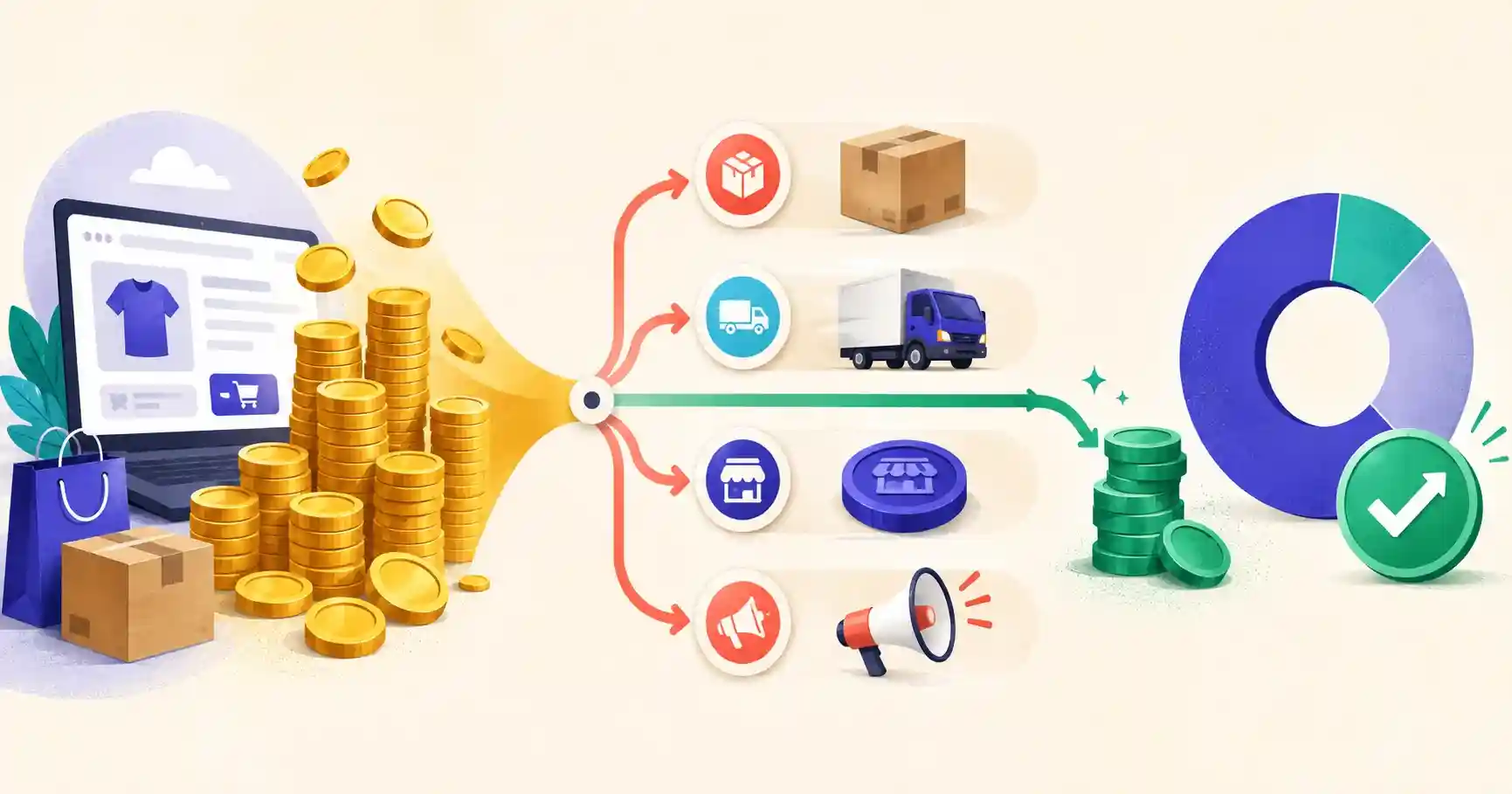
It is easy to underestimate how much stacks up between the sale price and your pocket. Here is a realistic breakdown for a $50 handmade item sold on Etsy with paid ads:
Sale price: $50.00
├── COGS (materials/product): $12.00
├── Platform/transaction fee (Etsy 6.5% + $0.20): $3.45
├── Payment processing (2.9% + $0.30): $1.75
├── Shipping & packaging: $6.00
└── Customer acquisition (ad spend): $8.00
= True net profit: $18.80  (37.6% net margin)
That $50 sale that felt like $38 of profit (after the $12 product cost) is really $18.80 once everything is counted. Sellers who price using only COGS routinely discover, months in, that they have been working for far less than they thought.
The hidden fee structures, platform by platform
Each marketplace layers on its own charges. Know them before you set prices:
- Etsy: a 6.5% transaction fee on the total order (item + shipping), a $0.20 listing fee per item, and roughly 3–4% payment processing. Optional Offsite Ads add a 15% fee on sales they attribute (12% for high-volume shops), capped per order.
- Shopify: a monthly subscription tier plus payment processing of roughly 2.4–2.9% + $0.30 per transaction via Shopify Payments. Using a third-party gateway adds an extra transaction fee on top.
- eBay: category-based final value fees, typically 12–15% of the total sale amount, plus a per-order fee.
The lesson: the same product can have very different net margins depending on where you sell it. Model each platform separately rather than assuming a single "fee percentage."
Target margin benchmarks
Aim for these healthy ranges based on your business model. If you fall well below them, your pricing or cost structure needs work.
| E-commerce model | Target gross margin | Target net margin |
|---|---|---|
| Handmade / craft (Etsy) | 70–85% | 30–50% |
| Private label / white label | 50–70% | 20–35% |
| Dropshipping / wholesale reselling | 20–40% | 10–15% |
Notice how thin dropshipping margins are — that model relies on volume and low overhead, and a single unexpected cost (a rise in ad prices, a wave of returns) can wipe out the profit entirely. Handmade sellers have more room per item but far less scale.
Markup vs margin: don't confuse them
A frequent pricing error is treating markup and margin as the same thing. Markup is how much you add on top of your cost; margin is profit as a percentage of the selling price. Buy an item for $50 and sell it for $100, and you have a 100% markup but only a 50% gross margin. Pricing off markup while thinking in margin terms leads to systematically underpricing. Decide which lens you are using and stay consistent.
How to account for returns
Returns are not an edge case; they are a cost of doing business. Build a standard return allowance — typically 3–5% of gross sales — directly into your overhead so your retail price absorbs the occasional refund, damaged item, or shipping mishap without turning a profitable order into a loss. Ignore returns in your pricing and your real net margin will always come in below your projections.
Calculate your store margins instantly
Spreadsheets are error-prone, and every platform's fee math is slightly different. These calculators do the arithmetic for you, accurately, in your browser.
Price for Real Profit, Not Guesswork
Eliminate spreadsheet mistakes and optimize your pricing with our free business calculators:
- 🛍️ Etsy Fee & Profit Calculator: Calculate exact transaction fees, Offsite Ad costs, and net profit per item.
- 🏪 Shopify Profit Calculator: Model product markup, payment processing fees, and net payouts.
- 📈 Profit Margin Calculator: Switch instantly between gross margin and required selling price.
- 🏷️ Markup Calculator: Turn a cost and a target markup into the right retail price.
🔒 100% client-side privacy: your sales data, supplier pricing, and revenue numbers are calculated entirely inside your browser.
Pricing strategies that protect your margin
Knowing your costs is step one; pricing so they are always covered is step two. A few strategies help:
- Price from target margin, not gut feel. Decide the net margin you need, then work backward through all fees and costs to the retail price. This guarantees profitability rather than hoping for it.
- Use keystone pricing as a floor, not a rule. The old "double your cost" heuristic ignores platform fees and ads, which is why so many sellers who "double up" still lose money. Treat it as a starting point and verify with real numbers.
- Raise average order value. Bundles, volume discounts, and upsells increase revenue per order without proportionally increasing fixed costs like shipping and acquisition — often the fastest way to lift net margin.
- Revisit prices quarterly. Supplier costs, ad prices, and platform fees drift. A price set a year ago may now be underwater.
The metrics that decide whether you scale profitably
Margin is the foundation, but two related numbers determine whether spending on growth actually pays: Customer Acquisition Cost (CAC) — what you spend in marketing to win one customer — and Average Order Value (AOV). If your ad-driven CAC is higher than the net profit on a first order, you are buying customers at a loss and betting on repeat purchases to recover. Healthy stores keep CAC comfortably below the profit per customer, or have a clear lifetime-value case for accepting a loss up front. Tracking CAC and AOV alongside net margin turns "we're busy" into "we're profitably growing."
Returns, chargebacks, and the hidden margin leaks
Beyond the obvious fees, several quiet costs erode margins if you ignore them: return shipping and restocking, chargebacks and their fees, payment-processing on refunded orders (some processors keep the fee even when you refund), and inventory that ages out or gets damaged. Build a realistic allowance for these into your overhead — for many categories, 3–5% of gross sales for returns alone is prudent. The sellers who survive are the ones whose prices quietly absorb these leaks rather than being blindsided by them at the end of the quarter.
Key takeaways
- Revenue is a vanity metric; net profit margin decides whether your store survives.
- Gross margin covers only product cost; net margin subtracts fees, shipping, ads, and returns.
- Every platform layers its own fees — model Etsy, Shopify, and eBay separately.
- Price from a target margin, not gut feel, and never confuse markup with margin.
- Build a 3–5% returns allowance into overhead and track CAC against profit per customer.
Frequently asked questions
What is the difference between markup and profit margin?
Margin is profit as a percentage of the selling price; markup is how much you increased the cost price. Buying at $50 and selling at $100 is a 100% markup but a 50% gross margin.
How do I account for customer returns in my net margin?
Build a return allowance of roughly 3–5% of gross sales into your overhead so your retail price comfortably absorbs occasional refunds and shipping damage.
Why is my revenue high but my profit low?
Because fees, shipping, packaging, and ad spend stack up between the sale price and your pocket. Calculate net margin — not just gross — for every product and platform to see the real picture.
Which platform has the lowest fees?
It depends on volume and product type. Etsy is simple for low-volume handmade goods; Shopify can be cheaper at scale but adds a monthly cost. Model each with a fee calculator rather than assuming.