Tools used in this post
Compound interest has been called "the eighth wonder of the world," and the line that usually follows is the important part: those who understand it earn it, and those who do not, pay it. That single sentence captures why the same force that quietly builds fortunes in an index fund also quietly buries people under credit-card debt. Whether you are saving for retirement, investing in the market, or trying to escape a balance that never seems to shrink, understanding compounding is one of the highest-return skills in personal finance — no pun intended.
This guide breaks down exactly how compound interest works, the formula behind it, how the frequency of compounding changes your results, and the strategies that let ordinary savers turn modest, consistent contributions into substantial long-term wealth.
Simple interest vs compound interest
The whole concept becomes clear the moment you contrast it with its simpler cousin.
- Simple interest pays you only on your original principal. Deposit $10,000 at 8% simple interest and you earn $800 every year, forever. The interest never grows.
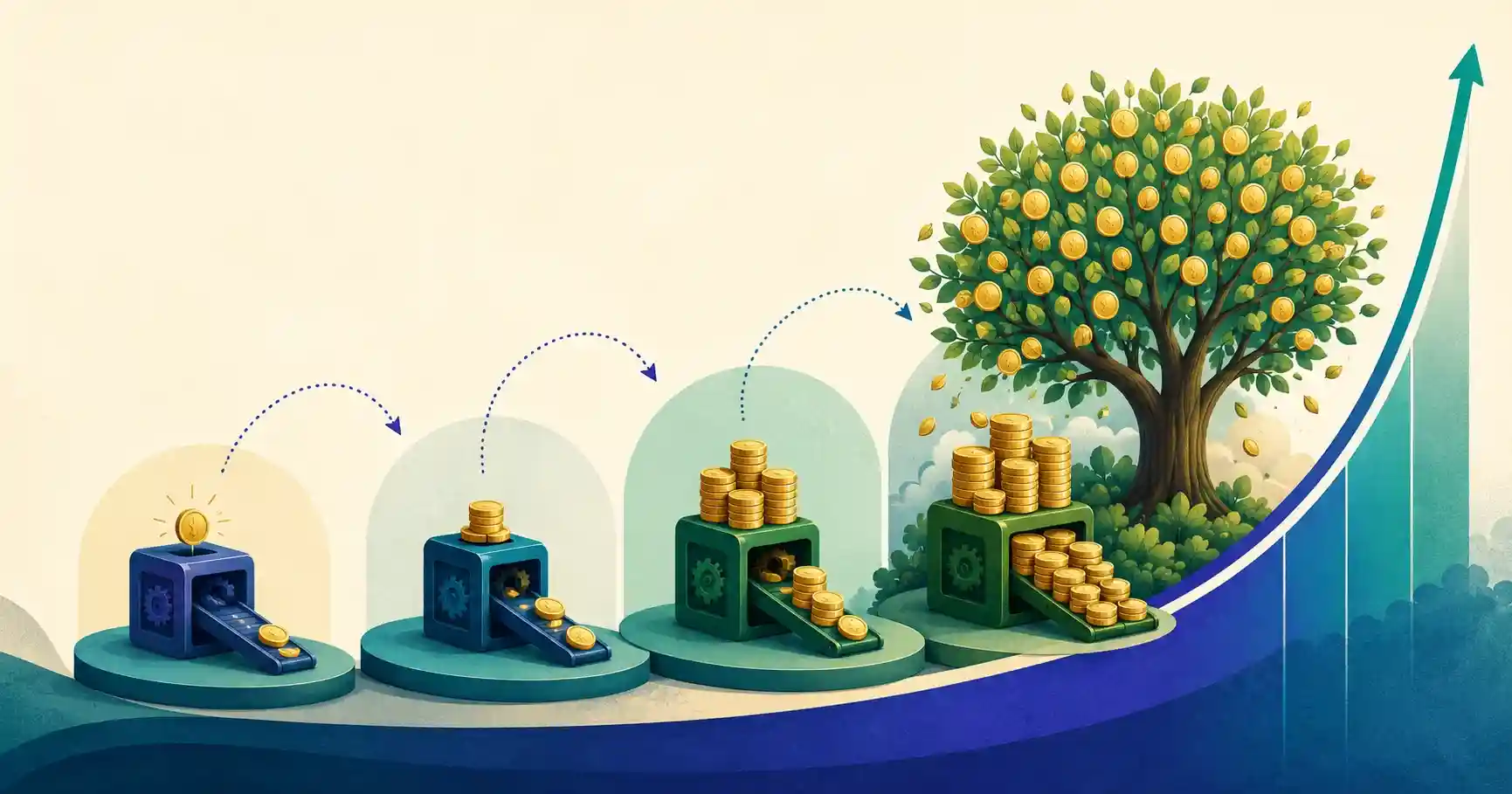
- Compound interest pays you on your principal plus all the interest you have already earned. Your interest starts earning its own interest, and the growth curve bends upward — slowly at first, then dramatically.
The gap between the two lines is the magic of compounding — and it widens every single year.
The compound interest formula
The math looks intimidating but is straightforward once labeled:
A = P × (1 + r/n)^(n·t)

A = final balance (principal + interest)
P = principal (your initial deposit)
r = annual interest rate as a decimal (7% = 0.07)
n = number of times interest compounds per year
t = number of years invested
Every lever in that equation is something you can influence: how much you start with (P), the return you seek (r), where you keep the money (n), and — most powerfully — how long you leave it alone (t).
How compounding frequency changes your returns
The more often interest is calculated and added back to your balance, the faster it grows, because each new interest payment immediately starts earning interest itself.
| Compounding frequency | Times per year (n) |
|---|---|
| Annually | 1 |
| Quarterly | 4 |
| Monthly | 12 |
| Daily | 365 |
The difference between annual and daily compounding on the same rate is real but modest compared with the difference that time makes. Which brings us to the most important variable of all.
Worked example: the power of time
Imagine investing $10,000 at an 8% average annual return, compounded monthly, and never adding another cent:
| Time elapsed | Balance | Interest earned |
|---|---|---|
| After 10 years | $22,196 | $12,196 |
| After 20 years | $49,268 | $39,268 |
| After 30 years | $109,357 | $99,357 |
Look closely at the interest column. In the first decade the money earned about $12,000. In the third decade alone it earned roughly $60,000 — nearly five times as much — despite no new deposits. That acceleration is compounding in its purest form, and it is why financial advisers relentlessly repeat one piece of advice: start early. A dollar invested in your twenties does work that a dollar invested in your forties simply cannot match.
The Rule of 72: compounding in your head
You do not always need a calculator to gauge compounding. The Rule of 72 estimates how long it takes to double your money: divide 72 by your annual return rate. At 8%, your money doubles in roughly 9 years (72 ÷ 8 = 9). At 6%, it takes about 12 years. It is a rough approximation, but it is remarkably handy for sanity-checking any investment pitch on the spot.
Compounding works against you, too
Everything above describes compounding as an ally. On the other side of the ledger, it is a ruthless opponent. Credit-card debt compounds — often daily, at rates far higher than any investment return. A balance at 22% APR is compounding against you faster than almost any legal investment compounds for you. This asymmetry is why paying off high-interest debt is frequently the single best "investment" available: eliminating a 22% compounding liability is a guaranteed 22% return, tax-free. Before chasing market gains, put the same compounding force to work by clearing high-interest balances.
Strategies to make compounding work for you
- Start now, not later. Time is the most powerful variable in the formula, and it is the one you can never get back.
- Contribute consistently. Regular deposits compound alongside your principal; automating them removes the temptation to skip.
- Reinvest everything. In investing, reinvested dividends buy more shares that generate more dividends — compounding layered on compounding.
- Kill high-interest debt first. Stop compounding from working against you before you optimize it working for you.
Model your growth for free
Seeing the numbers for your own situation is far more motivating than a generic example. These calculators run entirely in your browser.
See Your Money Grow — Run the Numbers
Model your financial future with our free, private calculators:
- 📈 Compound Interest Calculator: Project returns with custom monthly deposits, rates, and timeframes.
- 💹 Investment Returns Calculator: Compare growth across different assets and contribution plans.
- 💳 Credit Card Payoff Calculator: See how compounding works against you and plan a fast payoff.
🔒 100% client-side privacy: your investment amounts and financial figures run locally in your browser and are never stored.
The real fuel: regular contributions
The classic example — leave a lump sum alone and watch it grow — understates how most people actually build wealth. The bigger engine is consistent contributions compounding alongside your principal. Investing $500 a month at an 8% average return does not just add $6,000 a year; each contribution starts its own compounding journey, and after a few decades the growth dwarfs the total you put in. This is why automated, regular investing beats waiting to invest a big sum "someday": you give more dollars more time, and time is the variable that matters most. Set up an automatic transfer and compounding does the rest quietly in the background.
Inflation: the return you actually keep
An 8% return sounds great, but part of it is an illusion if inflation is running at 3%. Your real return — purchasing power gained — is roughly the nominal return minus inflation, so 8% nominal is closer to 5% real. This matters for two reasons. First, it is why holding large sums in cash is quietly costly: money earning 0.5% while prices rise 3% is losing about 2.5% of its buying power every year, compounding against you. Second, it sets realistic expectations: when you model your future with a calculator, remember the headline number is before inflation. Building the habit of thinking in real terms keeps your plans grounded.
Tax-advantaged accounts supercharge compounding
Where you hold investments changes how fast they compound, because taxes on dividends and gains act as a drag that itself compounds over time. Tax-advantaged accounts — retirement accounts and similar wrappers depending on your country — let gains grow without that annual tax leak, so more of every year's growth stays invested to generate next year's growth. Over decades, sheltering investments from tax can add a meaningful fraction to the final balance compared with an identical taxable account. The general lesson (not personal tax advice): understand the tax-advantaged options available to you, because using them well is one of the few "free" boosts to long-term compounding.
Frequently asked questions
What is the Rule of 72 in personal finance?
A quick shortcut to estimate how long it takes to double your money at a given annual return: divide 72 by the rate. At 8%, your money doubles in about 9 years.
Does compound interest apply to stock market investing?
Yes. Compounding occurs when you reinvest dividends to buy more shares and let capital gains accumulate over long horizons, so your returns generate further returns.
How often should interest compound for the best growth?
More frequent compounding (monthly or daily) beats annual, but the effect is modest next to the impact of time and contribution size. Focus first on starting early and investing consistently.
Is compound interest always good?
Only when it works for you. On savings and investments it builds wealth; on credit-card and loan balances it compounds against you, often at much higher rates, which is why paying off high-interest debt is so valuable.